Long Live the Villains: Five Scoundrels Who Own the Ballet Stage
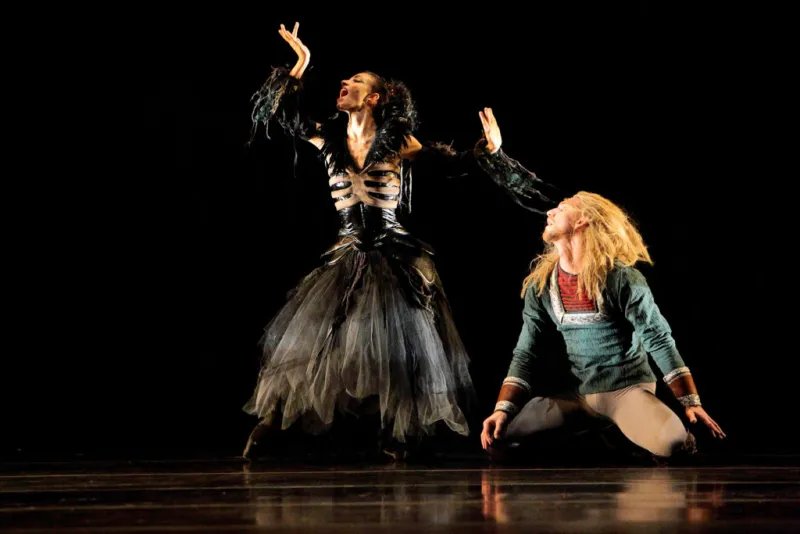
Photo: ballet villain stage performance dramatic costume dark, via pointemagazine.com
Here is a secret every seasoned balletgoer knows: when the curtain falls, it is often the villain the audience remembers longest.
The ballerina in white may break your heart, but the figure in black—the sorceress, the oath-breaker, the manipulator lurking at the edge of the fairy tale—supplies the story's electricity. Without them, the heroes have nothing to overcome. With them, an evening at the ballet becomes a contest.
Consider this your field guide to ballet's most delicious antagonists, with commentary from the character artists who bring them to life on our stage.
Carabosse — The Sleeping Beauty
The fairy tale's engine is not the sleeping princess; it is the fairy who was not invited to the christening. Carabosse storms the ceremony in a swirl of dark tulle and grievance, and everything that follows—the hundred-year slumber, the thorn-covered kingdom, the rescue—is her doing.
What makes her irresistible to audiences is her logic. She is not chaos; she is insult made theatrical. "The audience has to understand her," notes a GM Ballet character artist. "She was snubbed. Anybody who has ever been left off a guest list understands Carabosse. That's the hook."
Von Rothbart — Swan Lake
Rothbart is ballet's great puppet master. He cursed Odette into swan form, and he stalks every act of Swan Lake like a debt collector, appearing at the lakeside, at the palace ball, in disguise, always tightening the trap.
His genius as a stage presence is restraint. He rarely dances the way the lovers do; he arrives. A slow turn, a sweep of the feathered cloak, a gesture toward the prince—and the entire mood of the scene curdles. For beginner audiences, he is the easiest villain to spot and the most satisfying to boo.
Madge, the Sorceress — La Sylphide
Older than the other two, and stranger. In La Sylphide, the Scottish witch Madge reaches out to read the fortune of young James, who swats her away. Her revenge is elegant: she points him toward the sylph he already desires, knowing the pursuit will cost him everything.
Madge is a master class in understated menace. There are no grand entrances—just a shawl, a kettle, and a smile that never reaches the eyes. She is the villain next door, and that is precisely the problem.
The Fairy of Wrath — a Sleeping Beauty Cousin
Many productions of The Sleeping Beauty split Carabosse's function into the Lilac Fairy's shadow: a Fairy of Wrath or Carabosse's own attendants who carry the curse forward. These roles are a proving ground for young character artists—brief, wordless, and dependent entirely on presence. A single glare downstage can establish an entire production's stakes.
Hilarion — Giselle
Our final entry is human, which somehow makes him worse. Hilarion loves Giselle, suspects her mysterious new suitor Albrecht, and exposes the truth: Albrecht is engaged, and Giselle—deceived—loses her mind and dies. Then, in Act Two, he delivers her vengeful ghost's first victim.
Hilarion is ballet's study in jealousy wearing the mask of honesty. He is not wrong about Albrecht; he is simply ruinous in how he wields the truth. Audiences despise him, and a few quietly recognize themselves.
The Craft of Being Hissed
What do these five have in common? None of them thinks of themselves as evil. That is the first rule our character artists cite: a villain played as a villain is a cartoon. Played as a person—with motive, injury, and certainty—they become unforgettable.
The second rule is economy. Villains in ballet dance less and mean more. Every gesture is loaded. Where the corps de ballet fills the stage with motion, the antagonist needs one slow walk to command it.
So at your next performance, watch the dark figure at the edge of the story. Applaud the heroes, by all means. But when the audience around you draws breath at a villain's entrance—that low collective hiss—know that you are watching some of the finest acting on the ballet stage.
Every step tells a story. The villains tell the ones we cannot stop watching.