The Rehearsal Room's Living Archive: A Day With GM Ballet's Répétiteur
The Room Before the Room
At 9:47 on a Tuesday morning, the GM Ballet rehearsal studio is still empty enough to hear the radiators. Claire Donovan, répétiteur and ballet master, arrives with a score, a pencil, and a notebook whose pages look like a weather map of corrections. She does not warm up at the barre. She walks the room.
She checks the tape marks on the floor. She looks at the piano. She opens the score to a page she has known for two decades and reads it anyway. This is the part of the job audiences never see: the quiet preparation that makes a ballet legible before a single dancer enters.
A répétiteur is often described as a keeper of choreography. That is true but incomplete. The role is part archivist, part coach, part translator. The steps must remain intact, but they must also remain alive. A ballet can be technically correct and emotionally inert. Donovan's work begins where the notation ends.
Three Works, Three Vocabularies
Today's rehearsal is a mixed bill, which means the company is moving between three distinct worlds in a single morning. The first work is neoclassical, all speed and geometry. The second is a story ballet excerpt, full of mime and breath. The third is a contemporary piece with off-center balances and long, suspended phrases.
Donovan moves between them without visible friction. For the neoclassical section, she counts in crisp eights and watches the corps like a hawk. For the story excerpt, she speaks in images: remember the weight of the news, let the hand arrive before the face. For the contemporary work, she uses fewer words and more silence, letting the dancers find the phrase before she adjusts it.
The dancers call her corrections notes. The word is modest. A note can be a single finger placement, a shift in eyeline, a reminder that a turn is not a spin but a sentence with a beginning and an end. Donovan delivers them the way a good editor marks a manuscript: precisely, without drama, and with an eye on the whole page.
Corrections as Conservation
Midway through the morning, a young soloist rushes a sequence in the story ballet. The steps are there. The intention is not. Donovan stops the pianist with a raised hand.
You are arriving at the gesture already finished, she says. Let the music ask the question first.
The dancer tries again. This time, the hand-to-heart moment lands a half-beat later. The room changes. It is not a dramatic overhaul. It is a small act of conservation.
This is the répétiteur's real expertise: knowing which details are structural and which are interpretive. A wrong count can collapse a ensemble. A misplaced breath can flatten a character. Donovan keeps both in view. She is not there to impose a single performance. She is there to protect the architecture that allows many performances to exist.
The Memory in the Body
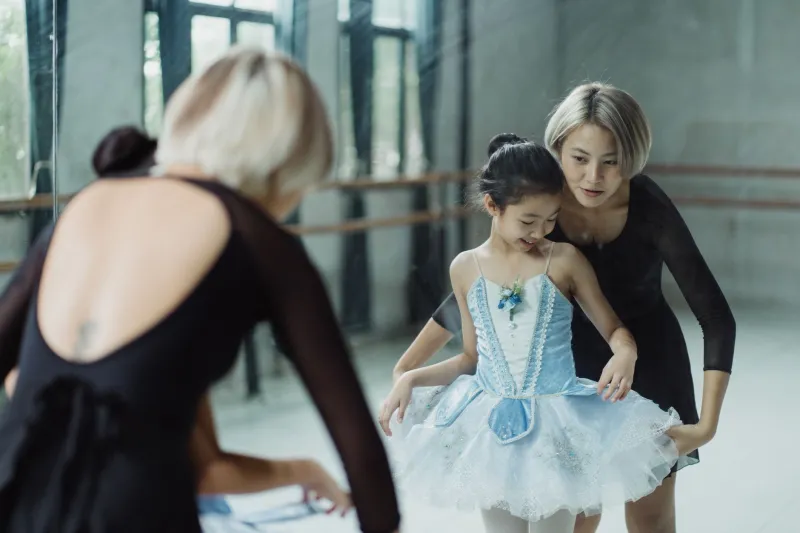
Later, a dancer new to the production asks about a transition that seems awkward on paper. Donovan does not answer with a diagram. She stands up and does it.
Her body remembers what the page cannot. She shows the weight shift, the slight delay in the shoulder, the way the gaze travels before the feet. The dancer copies her, then adjusts. Donovan watches and nods.
That is the transfer the job depends on. Choreography lives in bodies, but it survives through people who can explain it. A ballet's memory is not a locked vault. It is a conversation repeated across casts, seasons, and studios. The répétiteur is the one who keeps the conversation from becoming a monologue.
Quiet Notes Before the Run
By noon, the company is ready for a run-through. Donovan sits at the side of the room with her notebook open. She does not interrupt. She writes.
After the final chord, she gathers the dancers for notes. There are only six. A timing issue in the second work. A lifted chin in the third. A moment in the first where the corps needs to breathe together rather than merely move together. The notes take four minutes.
Then the room empties. Donovan stays behind, erases the tape marks, and writes a new page for tomorrow. The ballet has been rehearsed, corrected, and returned to its company. Her job is to make sure it will be there again in the morning.