Thirty-Two Flakes, Zero Collisions: The Backstage Arithmetic of GM Ballet’s Snow Scene
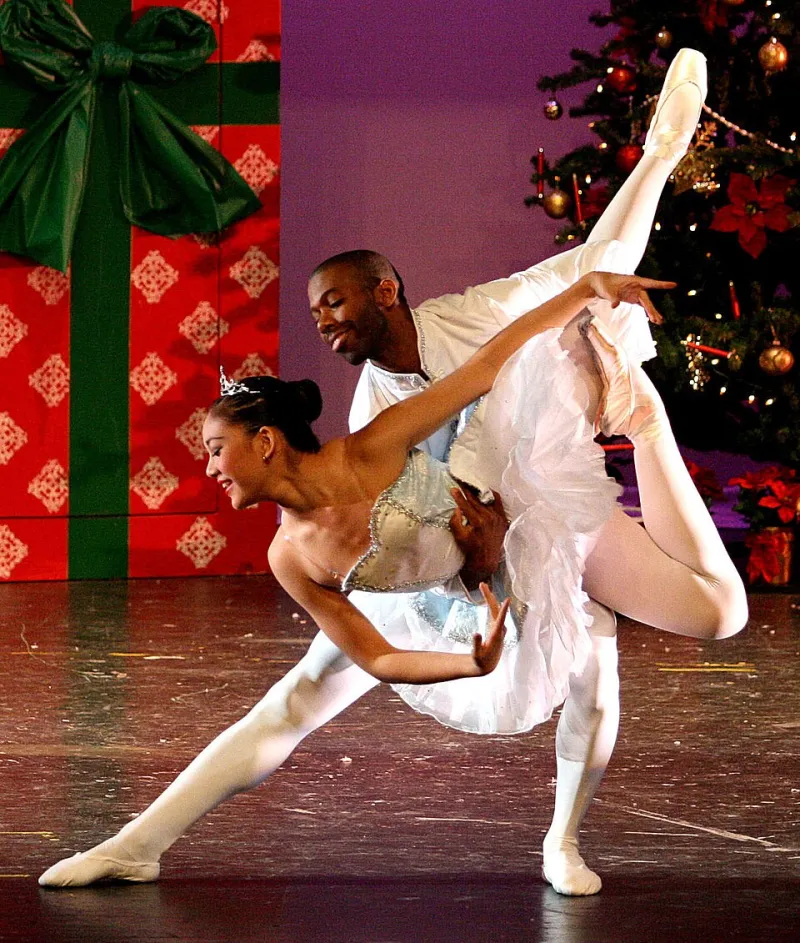
Photo: Lambtron, CC BY-SA 4.0, via Wikimedia Commons
The first snow of GM Ballet’s 2026 Nutcracker season does not fall from the sky. It rises from the wings, settles over the stage in measured waves, and disappears again on cue. To the audience, the snow scene is a moment of atmosphere—thirty-two dancers in white, a silver-lit stage, and paper flakes drifting through the air. Backstage, it is something closer to a scheduling puzzle. Every flake has a lane. Every lane has a dancer. Every dancer has a cover.
More Than a Pretty Blizzard
The snow scene arrives near the end of Act I, after the party scene’s child performers have cleared the stage and before Clara and the Nutcracker begin their journey. It is brief enough to feel like a breath and complex enough to absorb months of planning. The corps must enter in overlapping groups, sustain precise spatial relationships while traveling, and exit without breaking the visual line. Add falling paper snow, orchestral timing, and the need to reset the stage for the next scene, and the sequence becomes a moving equation.
For GM Ballet, the equation begins with the cast list—not simply who dances well, but who dances well in proximity to whom. Height, reach, turning direction, and recovery habits all matter. A dancer who travels slightly farther on a diagonal can be paired with a partner who compensates without appearing to. A dancer who is strong in one corner of the stage may be placed where the sightlines are most demanding. The goal is not uniformity for its own sake. It is a corps that looks inevitable.
Casting by Geometry
The company does not cast thirty-two snowflakes by drawing names from a hat. Rehearsal staff build a grid: stage left to stage right, front to back, entrance to exit. Each position carries a set of responsibilities. The outer lines must hold the shape of the stage picture. The center must anchor the flow of traffic. Dancers moving through the middle must navigate around one another without visible hesitation.
That grid is tested early. In the studio, rehearsal marks stand in for wings and curtains. Dancers learn not only their own paths but also the paths around them. A step that looks simple in isolation can become complicated when four other dancers are crossing the same area at the same time. The snow scene’s choreography is designed to make those crossings look like weather rather than traffic.
Casting also accounts for stamina. The snow scene follows a long first act, and many corps dancers appear in earlier ensembles. A dancer who has just come offstage from the party scene may need a moment to reset before entering the snow. The casting chart therefore tracks not only who is available but who is available in the right condition. Two dancers with similar technique can have very different Act I workloads.
The Clockwork of Costume and Quick Changes
Wardrobe adds another layer. Snow costumes must read as a single body of white under stage light, but they also must survive quick changes, close partnering, and the occasional snag on a wire or stair rail. GM Ballet’s wardrobe staff prepare multiple sets of tights, skirts, and headpieces, checking each piece for movement and security before the first dress rehearsal.
Quick changes are timed to the minute. A dancer who leaves the stage after the party scene may have only a short window to change before the snow entrance. Wardrobe assistants set costumes in sequence, often with labels and placement diagrams that would look familiar to anyone who has worked in a busy kitchen. The wrong sleeve in the wrong place can cost precious seconds.
The paper snow itself is its own logistics problem. It must fall convincingly, avoid slicking the floor, and be cleared efficiently between performances. Stage management coordinates the drop with the lighting and orchestral cues so that the snow supports the choreography rather than obscuring it. Too much paper and the stage becomes a hazard. Too little and the scene loses its hush.
Understudies in the Flurry
No casting plan survives a full season without adjustment. Illness, injury, and scheduling conflicts are ordinary facts of theatrical life. What matters is how the company prepares for them. GM Ballet’s snow scene uses understudy coverage designed around the same grid as the primary cast. Covers learn not only the steps but also the spacing and traffic patterns of the positions they may inherit.
That preparation is less glamorous than it sounds. It means watching from the wings, marking entrances, and rehearsing with partners who may never appear beside them onstage. It also means stage management keeps updated charts that show who can step into which lane and what adjustments follow. A single substitution can shift a neighboring dancer’s spacing by a few feet. The system absorbs that shift because it was built to.
What the Audience Doesn’t See
The snow scene is often described as magical, and it is. But the magic is not the absence of work. It is the work made invisible. It is the stage manager counting entrances in the dark. It is the wardrobe assistant checking a hem for the third time. It is the dancer in the wings mentally tracing a path that has been rehearsed since October.
For patrons, that invisibility is part of the pleasure. For students, it is a useful lesson: ballet is not only technique and artistry. It is also preparation, cooperation, and the willingness to trust a system larger than one person. The thirty-two flakes onstage are individuals, but they succeed as a shape.
When the snow begins to fall during GM Ballet’s 2026 Nutcracker run, the audience will see a winter landscape. Backstage, the company will see a plan holding steady—one lane, one cue, one dancer at a time.